



ICLS heads “Animalia” film event at Maison Française
February 17, 2026 – Topics of Interest
Printed in the Columbia Spectactor by Peter Bisbee
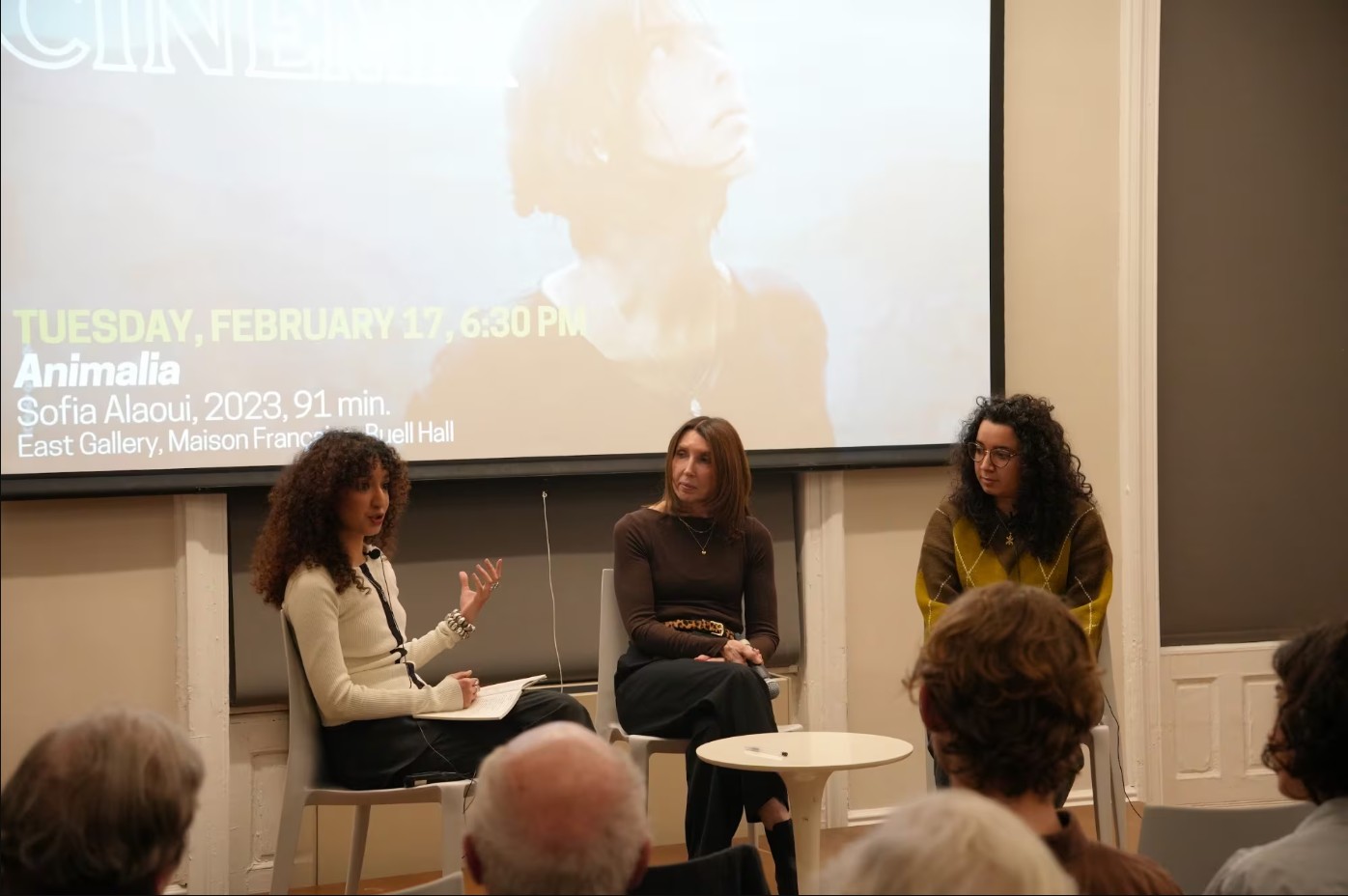
The screening of Animalia, the film debut of French-Moroccan director Sofia Alaoui was followed by a discussion with French and Comparative Literature doctoral candidates Chaima Benhsaina, GSAS ’32, Jihad Azahrai, GSAS ’31, and ICLS Director Undergraduate Studies and French Department Professor Madeleine Dobie (pictured).
Full Article
Staging a scholarly discussion on North African Indigenous identity, language, and cosmology, Maison Française hosted students and faculty Feb. 17 for a screening of French-Moroccan director Sofia Alaoui’s debut feature film, “Animalia”—winner of the World Cinema Dramatic Special Jury Award: Creative Vision at the 2023 Sundance Film Festival.
Following the screening in Buell Hall, the institute hosted a discussion moderated by Madeleine Dobie, professor of French and comparative literature, along with French and comparative literature doctoral candidates Chaima Benhsaina, GSAS ’32, and Jihad Azahrai, GSAS ’31.
The event is part of Maison Française’s ongoing public programming calendar, which includes film screenings, lectures, and panels to foster intellectual and cultural exchange between the United States, Europe, and the French-speaking world.
“Animalia” follows Itto, a pregnant Amazigh woman from a rural background, who marries into a wealthy urban family near Casablanca, Morocco. Throughout the film, Itto grapples with her position as an outsider in an elite social world—a struggle exacerbated when a mysterious supernatural phenomenon separates her from her husband and forces her along an intense and dangerous journey. The film shifts between Arabic, French, and Tamazight and layers crises of faith, class, and identity to ask the question of what truly shapes our sense of self.
Event organizers Benhsaina and Azahrai both have sustained academic interest in Morocco and the Amazigh, an Indigenous ethnic group in the Maghreb region of North Africa. Their scholarship is informed by lived experience, as Azahrai was raised in Germany in a Moroccan Amazigh family and Benhsaina grew up in Morocco’s Sous region in an Amazigh household.
The pair proposed the idea for the screening as part of the French department’s cinema programming, identifying “Animalia” as a film that addresses topics they felt had been overlooked in previous selections.
In an interview with Spectator, Benhsaina said earlier programs had explored censorship and politics but failed to thoroughly address the question of the Amazigh’s relationship with the French.
“We talk a lot about Francophonie and different depictions and different representations of different places,” Azahrai said in the interview. “[In the film,] there’s a play on different classes speaking French or not speaking French. I feel like this film can, just specifically here, also open up what the cinema looks like in different countries.”
The screening was followed by a pretaped interview with Johns Hopkins University Amazigh studies professor Brahim El Guabli, who interpreted the narrative surrounding Amazigh cosmology by contrasting its structure with that of conventional sci-fi narratives. While the genre traditionally relies on the creation of technologically-advanced futures or otherworldly beings, El Guabi noted that “Animalia” instead shifts through physical space, tracing Itto’s journey across Moroccan regions such as Imilchil and Khourigba—each differing in culture, class, geography, and dialect.